

Repair Techniques and Market Trends
Article by Jason Morgan
The shift back to repair is real and growing in heavy duty as greater emphasis is placed on repairability versus replacement.
Visit CRA’s industry news blog page for more relevant articles.
Collision repair is being redefined by what shops are capable of restoring. Materials have changed, vehicle architecture has evolved and the tools used on the shop floor now allow technicians to approach damage in ways that were not practical just a few years ago.
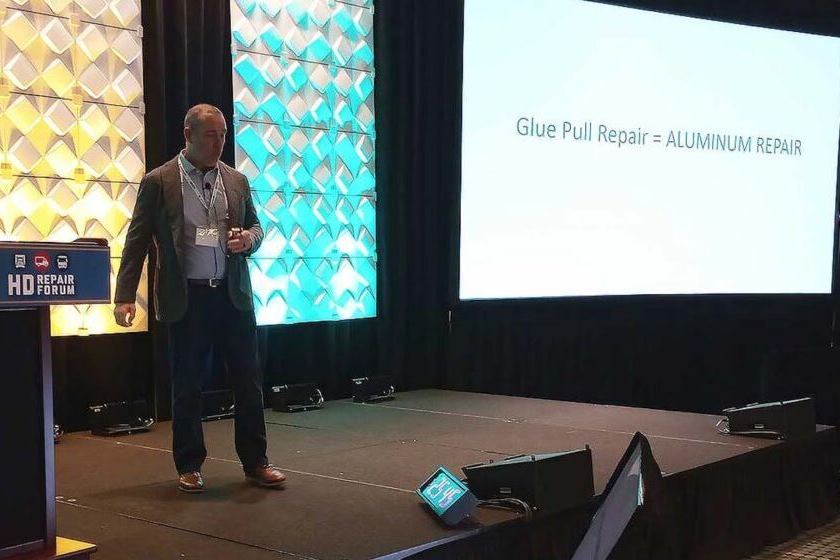
“I really feel that pendulum in the collision market swinging from replace back to repair,” said Chris White, president of KECO at the HD Repair Forum.
That movement is visible across the industry. Larger MSOs are placing greater emphasis on repairability. Shops are adjusting how they evaluate damage. Equipment development focuses on expanding what shops can repair rather than what they must replace. Today, repair is becoming a structured part of how technicians perform collision work.
Repairability Is Expanding in Aluminum and HD Applications
Material composition continues to shape repair strategy. Aluminum panels, now common across both passenger and heavy-duty vehicles, require a different approach than traditional steel.
“There’s so much aluminum, and fixing aluminum is difficult,” White said.
Repair processes are adapting to that reality. Glue pull repair provides a method that works with the material rather than against it, according to White. This expands the range of panels technicians can restore. Technicians can bring cab corners, quarter panels and large aluminum sections back into shape without removing material or disturbing the backside of the panel.
Heavy-duty vehicles bring additional scale to the process. Larger panels, thicker materials and limited access points require methods that can address damage without full disassembly. Repair allows shops to maintain structural integrity while restoring form. The result is a broader definition of what qualifies as repairable.
Repair Capability Drives Throughput Gains
Repair influences how work moves through the shop. When technicians can restore panels instead of replacing them, the process depends less on external factors.
“The other thing that repairing more does is help with that throughput,” White said.
Parts availability, shipping timelines and backorders introduce variability into production schedules. Repair reduces that variability by keeping more of the work inside the shop. Technicians remain engaged with the vehicle. Work progresses without interruption. Jobs move from one stage to the next with fewer delays.
In heavy-duty repair, this consistency supports better use of space and labor. Larger vehicles occupy more of the facility. Keeping those jobs moving helps maintain overall shop flow. Throughput becomes a function of capability rather than supply chain timing.
Repair Begins With Restoring Panel Tension
Damage affects more than the visible dent. The impact changes how the entire panel holds tension. Repair methods now address that condition directly. Lateral tension tools work across the damaged area, restoring balance within the panel before focusing on specific low points.
This process changes how technicians approach the work, White explained. Tabs are placed across the affected area. Tension is applied in multiple directions. The panel begins to respond as a whole. The repair progresses with the material rather than forcing it into position. The panel returns to form with fewer corrections and less finishing work.
This approach is especially important on larger HD panels, where localized force can create additional distortion.
Heavy-Duty Repairs Require Reach, Power and Modularity
The size of heavy-duty vehicles requires systems that can scale with the job. Accessing upper panels, wide surfaces and deep damage areas calls for extended reach and higher pulling capacity.
“We were at 1,200 pounds, eight feet in the air,” White said, describing tower capability designed for HD work.
That reach allows technicians to work on cab backs and upper structures without repositioning the vehicle or adding unnecessary teardown steps. Wide-panel repairs introduce another requirement. Damage that spans large sections must be addressed across the entire area.
“If an entire panel is 50 inches wide, you can’t just pull it a little bit at a time,” White said.
Technicians can link multiple tabs together to distribute force evenly. The system lifts the panel as a single unit, allowing the material to return to shape in a controlled way. Modular tooling supports this flexibility. Technicians can configure systems to match the size and shape of the repair, adapting to different vehicle types and damage conditions. For shops working on fleets and commercial vehicles, this expands the range of repairs they can complete without outsourcing or replacement.
Technician Skillsets Are Central to Repair Outcomes
Repair depends on how technicians interpret and respond to damage. The process requires observation, sequencing and control.
“There’s a skillset that has kind of left collision because of so much replace going on,” White said.
Rebuilding that skillset involves developing new habits. Technicians learn to read panel movement, understand tension and apply tools in a way that guides the repair.
“It’s not hard. It’s just a little bit different,” he said.
That difference shows up in daily work. Repairs are planned rather than rushed. Adjustments are made based on how the panel responds. The process becomes more deliberate. Consistency improves as technicians gain experience with these methods.
Training Connects Equipment to Performance
Equipment expands capability, but training determines how that capability is used.
“You’ve got a massive investment in that shop. Invest in your guys,” White said.
Shops that prioritize training see stronger results from their equipment. Technicians become more confident in repair decisions. More panels are restored instead of replaced. Work moves more efficiently through the shop. In heavy-duty repair, this connection is especially important. Each job carries more weight in terms of time, cost, and space. Effective use of equipment directly impacts profitability.
Training ensures that tools are applied with purpose and consistency.
Article Credit to BodyShopBUSINESS
Do you think there is a shift back to repair versus replacement in the heavy duty market? Let us know in the comments below. Also, if you found our content informative, do like it and share it with your friends.
Read Also: How To Check If You Have Outstanding Traffic Fines
Join the CRA Mailing List, It’s FREE
Click here to join the CRA mailing list, the innovative and trusted source for relevant motoring information and the latest news.
CRA is the innovative and trusted source for motoring information and the latest news to help entrepreneurs, business owners, managers and people working in the motor industry to stay informed and change their world. Get the advice your need to start, glow, and lead your business today. Get unlimited access to all articles.